





I. My Realization: The Hardest Part of Running a Server Isn’t the Tech—It’s the People
When I first started running a multiplayer Minecraft server, I assumed the biggest challenges were technical issues like configuration, plugin compatibility, and performance optimization.
It wasn’t until the server entered the phase of multi-person collaboration that I realized the truly maddening issues weren’t TPS drops or crashes, but rather “disasters caused by human error.”
Once, our guild server had been running stably for less than a week when a member responsible for “helping with maintenance” accidentally deleted the world save while cleaning up server files. To make matters worse, since everyone held nearly identical administrator privileges at the time, we couldn’t even quickly identify who had performed the action.
That moment made me realize a harsh reality:
When a server is managed by one person, the challenges are technical; when it involves a team, the challenge is permissions management.
From then on, I began redesigning our team’s permission structure. I ultimately utilized Shockbyte’s sub-user system to build a tiered model specifically tailored for multi-person collaboration.
II. Restructuring Permissions: Breaking Down “Administrator” into Five Distinct Roles
Based on past experience, I found that a “everyone is an admin” setup was the most dangerous approach. So, I divided the team into five roles, ensuring each person focused solely on their specific responsibilities.
The “Super Admin” role is reserved exclusively for my personal account, centralizing control over core permissions—including save management, core configuration changes, and permission assignments. The principle here is simple: never share this access, as a single mistake could lead to irreversible server loss.
The “Build Team” focuses on content creation. They handle map construction and visual optimization; while they can use building plugins and upload structure files, they cannot touch core server configurations or perform actions like restarting the server or deleting files. This allows them creative freedom without compromising server stability.
The “Operations Team” manages the player experience. They handle event organization, player management, and basic command operations—such as banning, kicking, or switching game modes. However, they cannot install plugins or access system-level configuration files, thereby avoiding any impact on the server’s underlying structure.
The “Technical Team” operates closest to the system core. They have permissions to install plugins, view logs, and restart the server, as well as monitor the server’s operational status. This tier represents the only users with access to the system’s operational logic, yet they remain strictly bound by limitations: they cannot delete save files or modify core world files.
Finally, there are guest accounts. This tier possesses virtually no administrative privileges and is intended solely for testing or temporary access. Functionality is restricted to basic entry and chat capabilities to eliminate the risk of accidental errors.
In Shockbyte’s sub-user system, this tiered structure can be implemented directly via the control panel, requiring no additional scripting.
III. The Crucial Factor: What Cannot Be Done, Not What Can Be Done

When designing permission structures, many server owners focus primarily on what privileges to grant users. However, the logic behind a truly stable server design works the other way around:
The priority is not what is permitted, but what is prohibited.
In my actual configuration, three categories of actions are strictly restricted.
The first category involves permission to modify core configuration files—such as server.properties and spigot.yml—which govern the server’s basic operation. Access to these files is reserved for super-administrators, as they directly influence startup logic; errors here can cause system-wide malfunctions.
The second category covers permission to delete world save data, including the Overworld, Nether, and End. Such actions carry high risk in any team environment; accidental deletion is often irreversible.
The third category involves file-level management privileges—specifically, direct access to the server’s file structure. In collaborative environments, this level of access is frequently the source of incidents and must therefore be strictly isolated.
Shockbyte’s permission system allows for granular control over these restrictions via sub-user roles, effectively preventing scenarios where a single accidental click could ruin the entire server.
IV. Plugins, Logs, and Restarts: Granting Only Essential Capabilities
Once the permission structure was stabilized, I proceeded to further refine the scope of the technical team’s capabilities.
Permission to install plugins is essential, as server functionality relies on them. However, I restrict this privilege to the technical team and forbid the deletion of core dependency plugins to prevent dependency chain failures that could stop the server from booting.
Log access is one of the system’s most critical capabilities; it is used not only for troubleshooting errors but also for tracking operational history. Server anomalies often stem from specific plugin interactions or player actions rather than total system crashes; without logs, identifying the root cause would be impossible. Server restart privileges represent one of the highest-risk operations; consequently, they are restricted to the technical team and super-administrators. This is because the restart process involves data saving, plugin loading sequences, and cache refreshing—areas where any error could lead to data anomalies.
Combined, these capabilities form a technical layer that is “maintainable yet indestructible.”
V. Audit System: Finally, I Truly “Know What Happened”
If permission control is about “preventing incidents,” then the operation logging system addresses “what to do after an incident occurs.”
In my current server environment, every critical action is fully logged—including logins, configuration changes, plugin installations, and server restarts. Even individual critical commands are timestamped.
I recall an instance where the server suddenly experienced abnormal latency. I initially suspected a hardware issue, but by tracing back through the logs, I discovered that an operations team member had repeatedly triggered high-load commands while testing an event plugin.
The entire troubleshooting process took less than a few minutes; without a logging system, diagnosing such an issue could have taken hours or even longer.
With Shockbyte’s audit mechanism, these operation records are generated automatically—a feature that is crucial for servers involving multi-person collaboration.
VI. What Kind of Servers Benefit from This System?
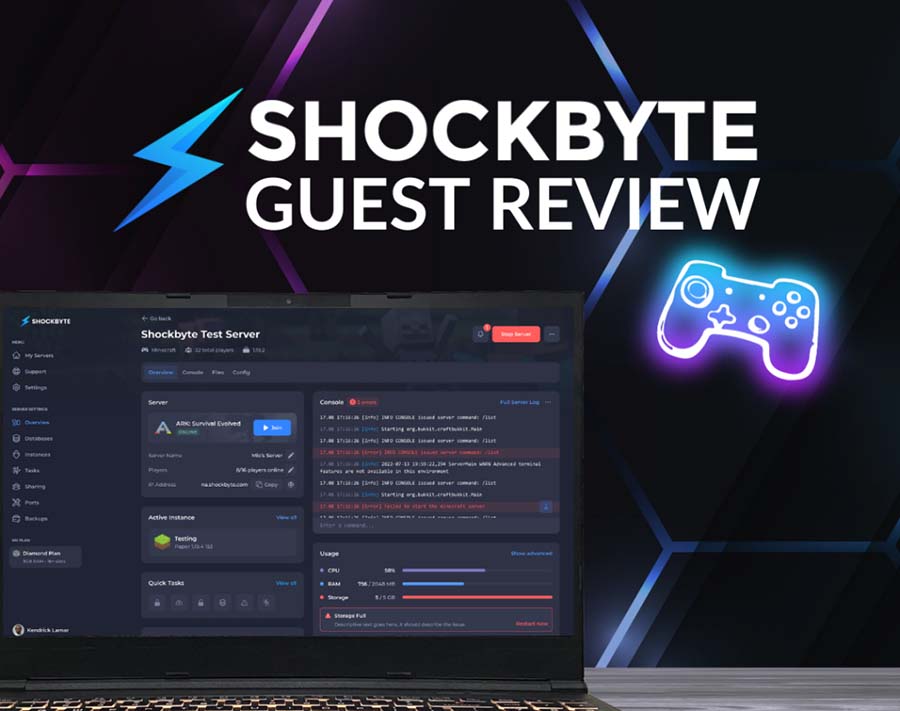
While this permission system isn’t mandatory for every server, it is virtually essential for servers operated by multiple people over the long term.
This is especially true for guild servers; with large, frequently changing memberships, accidental errors are common. Long-term survival servers prioritize stability, as a single mistake could ruin a long-standing save file. This structure is also ideal for part-time operations teams, where membership fluctuates—clearer permissions mean greater security. Finally, content-driven servers—such as event or role-playing servers—can leverage this structure to achieve a more professional division of labor.
VII.From “Firefighting Admin” to “System Manager”
Before using Shockbyte, I spent nearly every day dealing with server crises—plugin conflicts, accidental file deletions, configuration errors, and crashes requiring restarts in the middle of the night. The server was rarely truly stable.
However, after implementing this permission system, the situation changed dramatically. The build team could focus on content creation, the operations team on player experience, and the technical team on system maintenance, leaving me to handle only the overall architecture and key decisions.
Most importantly, the server no longer suffers from frequent, “unexpected deaths.”
VIII.Permission Hierarchies Are Not Restrictions, But the Foundation of Team Efficiency
When setting up a multiplayer server for the first time, many people assume that having more permissions equates to greater convenience; however, actual operation reveals that disorganized permissions are the greatest source of risk.
By utilizing Shockbyte’s sub-user system, I ultimately achieved three things: isolating risks, segregating responsibilities, and ensuring operational transparency.
When a server enters the phase of multi-person collaboration, its long-term stability depends not on high-end hardware specifications, but on a well-designed permission structure.











+ There are no comments
Add yours